
George Headley: Biography, Career & Stats
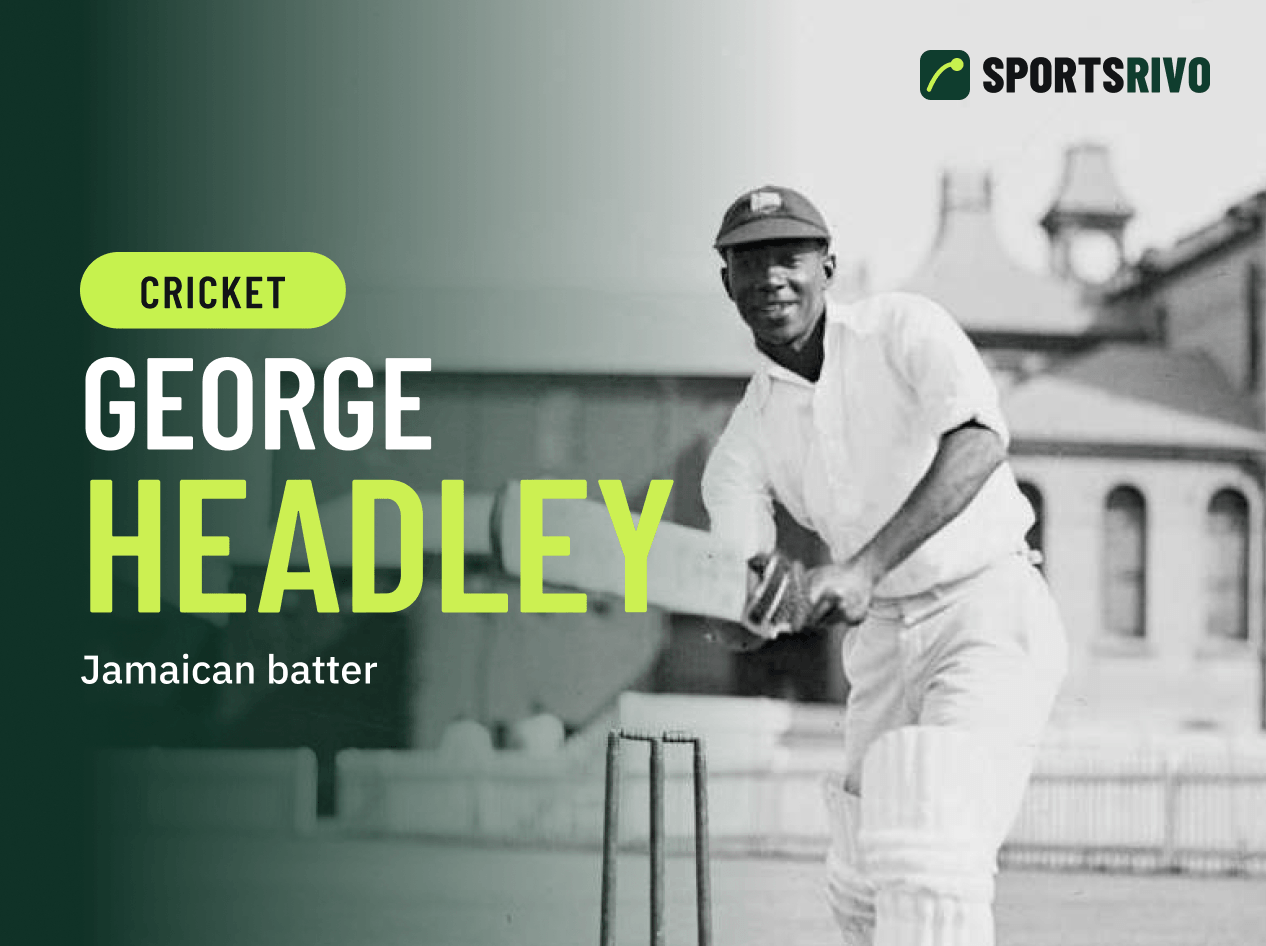
George Headley was a Jamaican batter who became the first great Test batsman produced by the West Indies. Batting at number three, he scored 2,190 runs in 22 Tests at an average of 60.83, including 10 centuries, eight of them against England. His fans called him the “Black Bradman”.
ICC Hall of Fame inductee (2009)
Wisden Cricketer of the Year 1934
60.83
22 Tests · 1930–1954
2,190
10 centuries · 5 fifties
270
v England · Kingston 1935
344
9,921 runs · average 69.86
Athlete Profile
Headley carried the West Indian batting order through the 1930s and is still the yardstick for the region’s top-order batters. The key facts about his life and game are below.
Full name
George Alphonso Headley
Born
30 May 1909, Colón, Panama
Died
30 November 1983, Kingston, Jamaica (aged 74)
Nicknames
“Black Bradman”, “Atlas”
Role
Right-handed top-order batter (usually at number three)
Teams
West Indies, Jamaica
Test debut
1930 v England, Bridgetown
Last Test
1954 v England, Kingston
Honours
Wisden Cricketer of the Year, MBE, Order of Distinction (Jamaica), ICC Hall of Fame
Early Life
Headley was born in Colón, Panama, to a Barbadian father, DeCourcy Headley, and a Jamaican mother, Irene Roberts. The family later moved to Cuba, and in 1919 his mother took him to Jamaica so he could attend an English-speaking school. He grew up in Rae Town, Kingston, and went to Calabar Elementary School, where he kept wicket without gloves.
He scored his first century at 16 for the Raetown club. Headley planned to study dentistry in the United States, but his early success in first-class cricket changed that plan.
Batting Career
Headley’s career ran from a first-class debut in Jamaica to a last Test at 44, with the Second World War removing a large part of his prime. These are the key stages.
First-class debut for Jamaica
Headley made his first-class debut for Jamaica against Lord Tennyson’s XI at Sabina Park on 9 February 1928. In the second match he scored 211, his maiden first-class century, and he finished the series with 409 runs at 81.80.
Test debut and a record-setting series against England
In his first Test, against England in Barbados, Headley scored 176 in the second innings, the first century by a West Indian on Test debut. In the third Test in British Guiana he made 114 and 112, the first West Indian to score two hundreds in a Test, and he added 223 at Kingston in the fourth. He ended the series with 703 runs at 87.87.
First hundred against Australia
On the tour of Australia the West Indies lost the series 4–1 but won the fifth Test, their first victory over Australia. Headley scored 102 not out at Brisbane, the first West Indian century against Australia, and made 1,066 first-class runs on the tour. He changed his stance and footwork to deal with leg-side bowling plans, and Donald Bradman praised the adjustment.
Wisden Cricketer of the Year
On the 1933 tour of England, Headley scored 2,320 runs with seven centuries at an average of 66.28, more than 1,000 runs ahead of any other tourist. He made 169 in the second Test at Manchester and was named a Wisden Cricketer of the Year the following spring.
League cricket in Lancashire
Headley signed with Haslingden in the Lancashire League in September 1933. In 1937 he set a league record with 1,360 runs in a season at an average of 97.15, and in 1938 he also took 76 wickets at 9.70.
270 not out and a first series win over England
At Kingston in the fourth Test against Wyatt’s MCC side, Headley batted for 495 minutes and made 270 not out, with 30 fours. It stayed the West Indian Test record until Garfield Sobers scored 365 not out in 1958. Headley scored 485 runs at 97.00 in the series, and the West Indies won 2–1, their first Test series win over England.
Two hundreds in one Test at Lord’s
On the 1939 tour of England, Headley made 106 and 107 in the first Test at Lord’s, the first player to score two hundreds in a Test at the ground. He scored 1,745 first-class runs on the tour at 72.70 and topped the English season’s averages. The team was in Canada on the day Britain declared war on Germany, and the tour was cut short.
War years and a return to Jamaican cricket
His Lancashire League contracts were cancelled, and Headley worked in the Labour Department in Jamaica and captained Lucas to three Senior Cup wins. He took over as Jamaica captain in March 1947 and scored 203 not out against Barbados that year.
First black captain of the West Indies
Headley was named one of the West Indies captains against England in 1948, the first black player given the role. He led the side in one Test, in Barbados, before a back injury ended his series.
English league cricket and a last Test
He played for Bacup in 1950 and then for Dudley, where he scored 2,878 runs and took 102 wickets. In 1954 a public subscription raised more than £1,000 for his fare home so he could be recalled to the West Indies team. He played his last Test at Kingston aged 44, scoring 16 and 1, and the West Indies won by 140 runs.
Career Statistics and Honours
Headley played only 22 Tests, but his record per innings is among the best the game has produced. The tables below show his main batting numbers and the awards he received.
Medals and marks
| Mark | Detail |
|---|---|
| Test batting average | 60.83, third-highest of any batter with 2,000 Test runs, behind Donald Bradman and Graeme Pollock |
| Test centuries | 10 in 40 innings (one every four innings, second only to Bradman); eight against England, two against Australia |
| Average in wins | 95.75 in five Tests won |
| First-class record | 9,921 runs at 69.86, 33 centuries |
| Wisden Cricketer of the Year | 1934 |
| MBE | 1956 |
| Honorary life member of the MCC | 1958 |
| Norman Manley Foundation Award for Excellence in Sports; Order of Distinction (Jamaica) | 1973 |
| ICC Hall of Fame | Inducted 2009 |
Test and first-class batting
| Format | Matches | Innings | Runs | Highest | Average | 100s / 50s |
|---|---|---|---|---|---|---|
| Tests | 22 | 40 | 2,190 | 270* | 60.83 | 10 / 5 |
| First-class | 103 | 164 | 9,921 | 344* | 69.86 | 33 / 44 |
Before the Second World War, Headley scored 2,135 runs in 19 Tests at 66.71. In 1931–32 he shared a sixth-wicket stand of 487 with Clarence Passailaigue, which was a first-class world record for that wicket. He is, with Bradman, one of only two batters to average more than 60 in both Tests and first-class cricket.
International Career
Headley played all 22 of his Tests for the West Indies between 1930 and 1954, and 21 of them were against England or Australia. His 703-run debut series in 1930 and his 485 runs in 1934–35 shaped the team’s first big results against England.
The West Indies won their first Test against Australia in 1930–31 and their first series against England in 1934–35, both with Headley’s runs at the centre of the performance. At home he and the opener Karl Nunes added 227 for the second wicket at Kingston in 1930. After the war he played only three more Tests, in 1948, 1948–49 and 1954.
Headley captained the West Indies once, in 1948, and was the first black player to lead the team in a Test.
Legacy
Headley died in Kingston on 30 November 1983, aged 74. C. B. Fry called him “Atlas” for the way he carried the West Indian batting, and the Jamaican prime minister Michael Manley later described him as the yardstick for the region’s batters. In 1988 Bradman said the nickname “Black Bradman” should really have been the other way round.
A bronze head of Headley was unveiled at the National Stadium in Jamaica in 1969. His family is the first to produce three generations of Test cricketers: his son Ron played for Worcestershire and Derbyshire and was capped twice by the West Indies in 1973, and his grandson Dean played Test cricket for England. Another son, Lynn, reached the 100m semi-finals at the 1964 Olympics.
FAQ
Commentators gave him the name because his scoring record was close to Donald Bradman's. He averaged 60.83 in Tests, and only Bradman scored Test centuries at a faster rate. He was also called "Atlas" because he carried the West Indian batting.
He played 22 Tests for the West Indies between 1930 and 1954, scoring 2,190 runs. Few Tests were played in his era, and the Second World War stopped international cricket for most of the 1940s.
His highest Test score was 270 not out against England at Kingston in 1935. His highest first-class score was 344 not out.
Yes. He was named a captain for the 1948 home series against England, the first black player to hold the role, and led the side in one Test at Barbados.
He was born in Colón, Panama, on 30 May 1909 and moved to Jamaica as a child. He represented Jamaica and the West Indies.
Yes, he was inducted into the ICC Cricket Hall of Fame in 2009.
Dean Headley, who played Test cricket for England, is his grandson. Dean's father Ron also played Tests, for the West Indies.